

I didn’t join the Marine Corps for country or adventure. I joined because I wanted to be rich.
I was living in Columbus, Georgia, Fort Benning country, army town through and through, and I’d been reading Napoleon Hill. He said discipline was a characteristic of wealthy people. So I went looking for discipline the way you’d shop for a tool. I asked everyone I knew in uniform where to find it. Every one of them said the same thing: if you want discipline, join the Marine Corps.
So I walked into the recruiter’s office. He started his pitch, travel, education, benefits. I stopped him. I didn’t want a sales presentation. I wanted to know what it actually did to a person. He dropped the script and said it changed his life. That was enough. I picked my MOS on a Saturday. By Wednesday I was gone.
Boot camp puts a lot of words on walls. Most of them you forget. One stayed with me: You cannot be disciplined in great things and undisciplined in small things.
That’s it. That’s the whole lesson, and I’ve never found a better one. Make your bed. Shave every day. Not because those things matter in themselves, but because the same muscle that does the small thing does the hard thing. Discipline and consistency aren’t two different qualities. Consistency is just what discipline looks like when nobody’s watching.
When I joined, I started shaving my head. Not because I was losing my hair — I was twenty-two. But a weekly haircut was expensive, and I had a good shape to my head, so I shaved it instead. Same thing, same time, no variation. When I got out, I kept doing it. Nobody told me to. Nobody was grading me. That’s the point. The Marine Corps didn’t just teach me to follow a standard. It taught me to set one and hold it myself.
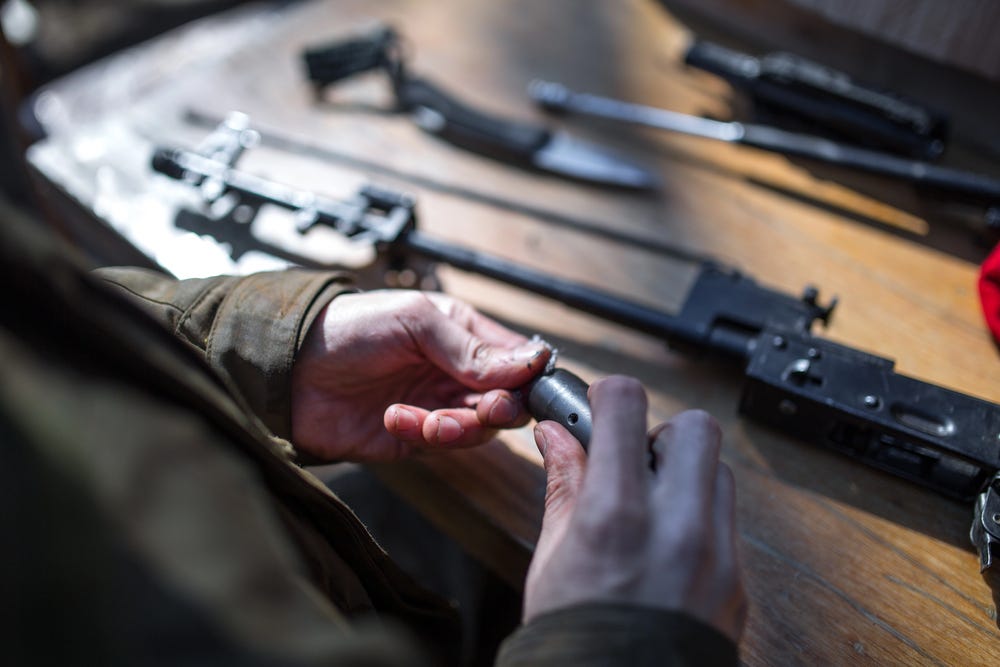
The other one came from a competition, blindfolded disassembly of an SAW, a squad automatic weapon. Machine gun, no sight, fastest time wins. The guys who yanked and rushed jammed the parts. The guys who moved with control finished first. Smooth is fast. Force doesn’t beat precision. I use that in every deadline, every difficult conversation, every moment where the instinct is to muscle through.
Most of my time in uniform was overseas. Japan. Korea. Vietnam. The Middle East after September 11. In those places, hypervigilance isn’t a flaw. It’s the job. You track exits. You sit facing the door. You notice who’s in the room before you settle in. The body learns to run that program automatically, and it runs it whether you need it or not.
I’ve been out for nearly twenty years. The vigilance hasn’t fully left.
I don’t need to know every exit anymore, but I need to know one or two. I can’t sit with my back to a door in a restaurant. The logic of that situation doesn’t compute for me the way it apparently computes for everyone else who’s never had to think about it.
I’ve done the work. I’ve gotten better. The acute edge is gone. But the baseline is still higher than civilian default, and I’ve made a kind of peace with that. Some things you don’t unlearn so much as renegotiate.
In boot camp I slept on top of the covers so my rack stayed made. I was already awake when the drill instructors came through the door in the morning. Already dressed. Already online.
I still sleep that light.
If you touch me while I’m sleeping, I wake up ready to fight.
The Corps never gave me discipline. It gave me a measuring tape and a mirror. Everything else is reps.