In high school choir, I closed my eyes a few notes before the final note of a verse. The sound came back and overtook me. No one was telling me what to do. Just the music and the moment. I had been in All-City and All-State chorus since eighth grade. I sang a solo on stage at my graduation. I loved it. Not the performance of loving it. The actual thing.
Then I went to Kennesaw State University on a full voice scholarship.
They said I needed hours in the practice room every day. Piano. Music theory. Memorizing composers. They said I would either teach or perform. The love for music stayed. The desire to do it under those conditions did not. Within a year, it had become a job I didn’t want, and I left.
I thought the problem was music.
It wasn’t.
In the Marine Corps I became a combat photographer. We were the last class at the Defense Information School to go through wet processing. Nikon F2 cameras, complete darkness, chemicals by feel, film on a spool. Light on paper. A romantic art that doesn’t exist anymore. I remember liking it. Actually liking it.
Then I got out in the field with grunt units, and the gunny would tell me what to shoot. This wound. This corpsman. This thing over here. I used to think about Michelangelo painting the Sistine Chapel with someone behind him saying paint that one orange, maybe go lighter on this angle. That’s what it felt like. The intrinsic motivation to see anything dried up fast.
I documented. I came back. Processed. Burned to a CD. I went out and documented again.
There was one deployment to Australia, Operation Tandem Thrust, where other photographers were there. Marines and Navy. On one of the evenings after everyone returned from their assignments, someone said: go out, shoot whatever you want, one hour, come back and we’ll see who has the best photo. I remember thinking, this is what it’s supposed to feel like. I saw it clearly in that moment.
Then the deployment ended and I went back to a Marine Corps base where they didn’t do things like that.
I buried it.
Years later, Professor Dziemian at Georgetown handed back an assignment and told me I had gutted my own work trying to imitate my classmates. He said: why did you change any of this? You were doing so much better. You have to trust yourself. I hadn’t trusted myself. I had looked at two other people’s work and decided mine was worse, without knowing whether theirs was even good.
What I had done in that classroom was exactly what I had done in the field. I listened to them instead of myself.
Cal Newport has a line I’ve come back to a few times. He writes that a calling is work that’s an important part of your life and a vital part of your identity. Not a job, not a career. A calling.
I didn’t get there by finding the right work. I got there by finally trusting what I already knew.
Writing is where I found it. I run the VA ORD inbox. I write stories about veteran suicide research. I conduct interviews, draft, edit, send. There are days it feels like a job. But the initial story is mine. The direction is mine. When my editor says something I wrote hit him like a freight train, I feel it. When I read something back and it finally says exactly what I was thinking when I was trying to write it, I feel that too.
It’s the same as the choir note. The sound going out and coming back.
I carried photography with me the whole time, even when I wasn't shooting. A fellow instructor once pushed me out of the house on a Saturday and told me to go to the Maryland Renaissance Festival with a press badge. I didn't have an assignment. Nobody told me what to shoot. I walked around and photographed whatever caught my eye. Somewhere in that roll is a picture of the woman I would eventually marry, taken the day we met. I didn't know that's what I was doing. I was just finally shooting without anyone behind me.
Here is what I know now that I didn’t know in the field with the grunt unit or in the practice room at Kennesaw State: the art doesn’t die when the work gets hard. It dies when you stop trusting yourself enough to protect it.
The gunny telling me what to shoot wasn’t the problem. Michelangelo had the Pope. The problem was that I let the orders be the whole of what I saw.
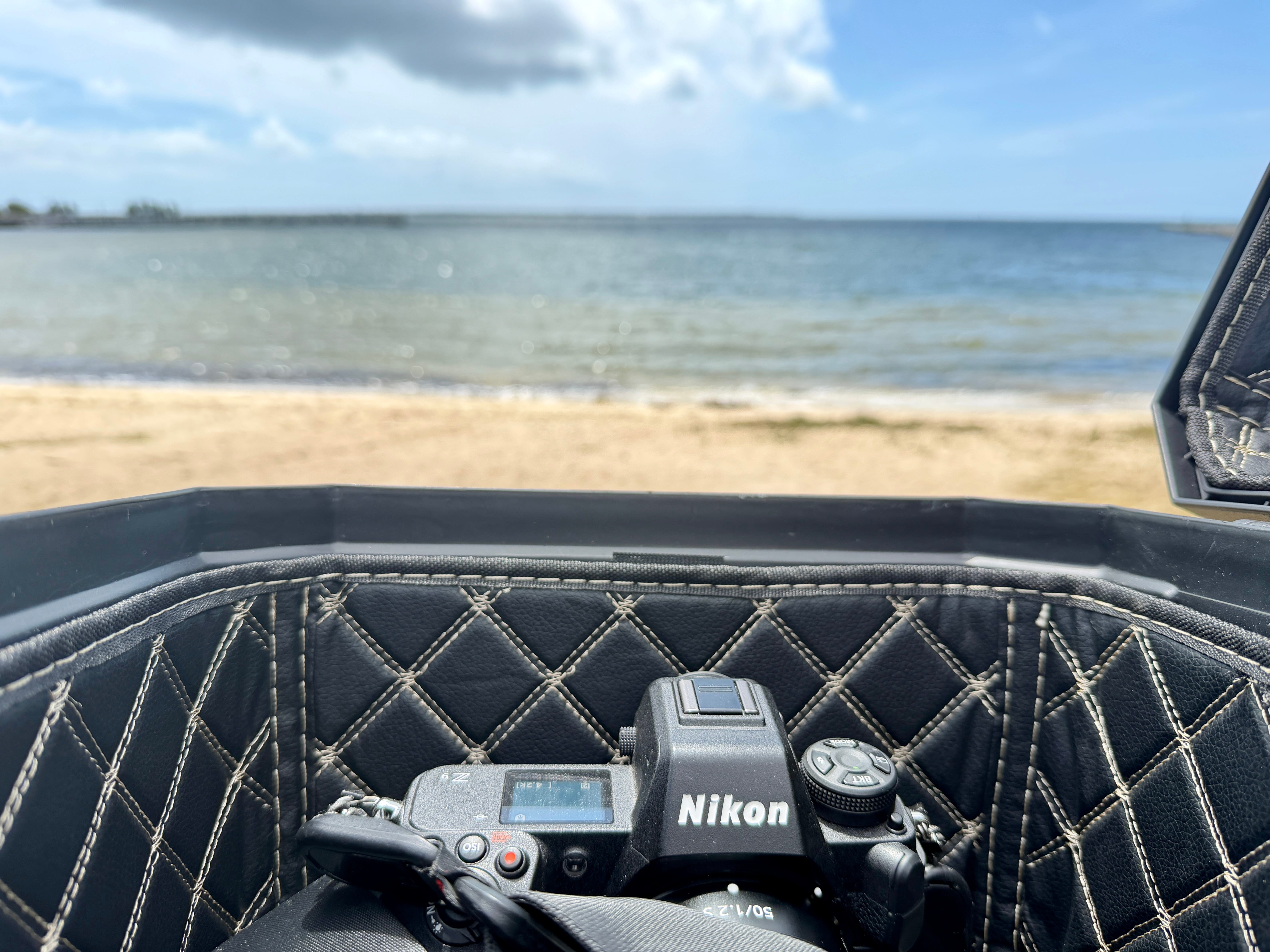
A few weeks ago I told someone I was going to put my camera in the trunk of my bike and go shoot. Beach photography. Self-assigned topics. Whatever I wanted.
Nobody gave me permission to do that.
I gave it to myself.
That's all it ever takes. It was always all it ever took.